I was seated in a meeting with the tech team today, discussing some issues we'd been experiencing in prod. Fairly normal stuff when you work in tech, I suppose. Something that worked perfectly fine a few months ago suddenly doesn't, and now everyone is trying to figure out what went wrong.
At some point, our CTO acknowledged that perhaps we could have made different decisions along the way. Maybe we'd have chosen a different approach, or anticipated some of the challenges we're dealing with today.
And idk, something about that admission really stuck with me.
Here's someone who's incredibly experienced, someone who knows far more about technology than I probably ever will, openly admitting that we could have done things differently.
My manager does this quite often too. And I don't say this lightly, he's probably the smartest and wisest person I've ever had the opportunity to work with. I've learned so much just from listening to how he thinks through problems. Yet, every now and then, he'll look at something we've done and acknowledge that perhaps we got it wrong, or that there was a better way we could have approached it.
I really admire that about him. There's something about being incredibly knowledgeable and still being comfortable admitting that you don't have all the answers.
Anyway, the conversation was about technical debt, but naturally, my mind wandered somewhere completely different, lol.
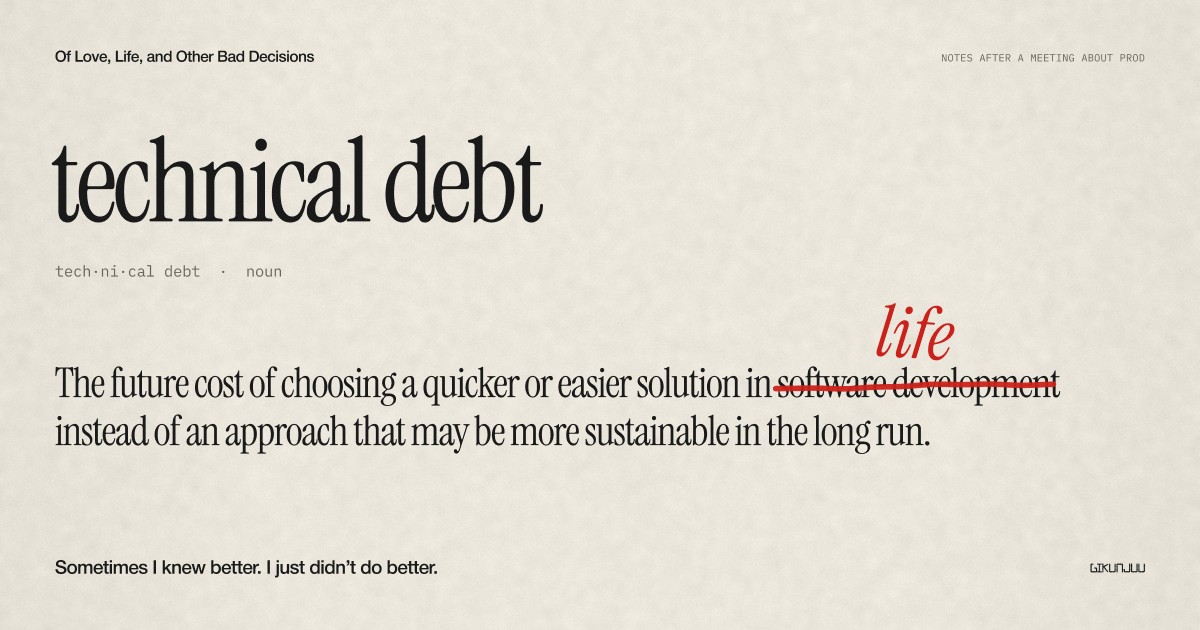
technical debt /ˈtɛknɪkəl dɛt/ noun: The future cost of choosing a quicker or easier solution in software development instead of an approach that may be more sustainable in the long run.
Essentially, you make a decision that works for you today, only to discover months or years later that it's become a problem. And the funny thing is, the decision might have been perfectly reasonable at the time. You just didn't know what you know now.
Which got me thinking, how much technical debt have I accumulated in my own life?
The Decisions We Make
Think about it. You leave a job for another one that pays significantly better, only to realise six months later that the environment isn't nearly as good as the one you left. Or you choose not to move to a new city, convinced that staying is the more sensible decision, then spend the next year wondering about all the opportunities and experiences you might have missed.
And then there are the people you choose to share parts of your life with. The relationships you invest in, the ones that change over time, and the ones you only really begin to understand when you're looking back at them. Sometimes you wonder whether you could have been a better friend, a better partner, or simply a better person to someone who mattered to you. Not necessarily because you wish things were different today, but because you've grown enough to recognise where you could have done better.
And sometimes it's the smaller things. The conversations you didn't have, the friendships you let fade, or the disagreements that probably didn't need to become disagreements in the first place.
You make these decisions based on who you are at that particular moment. What you know, what you want, what you think is important. And then you grow older, your priorities change, and suddenly you're looking at those same decisions wondering what on earth you were thinking.
I've had a few of those moments myself.
There are situations where I wish I'd been more patient. Times when I was so convinced I was right that I didn't really stop to consider someone else's perspective. And things I probably should have appreciated a lot more than I did.
And if you're reading this and you've ever been on the receiving end of that version of me, I'm sorry. For the times I didn't listen as well as I should have, or let my pride get in the way of something that really didn't need to be that complicated. There are conversations I'd handle very differently today, and I think you deserve to know that.
I don't know if everything can be made right, or if some things are better left as they are. But I'd like to believe that some conversations are still worth having, even if they come a little later than they should have. And if there's one you think we never quite finished, you can always reach out. I'd be happy to listen :)
I can't even hide behind the whole "I did the best I could with what I knew" argument, because sometimes I knew better. I just didn't do better.
And that's quite an uncomfortable thing to admit, haha.
But I suppose that's part of growing up. Realising that you weren't always right, even when you were absolutely convinced you were.
The Good Old Days
There's this scene in The Office, Season 7, where Michael is leaving Dunder Mifflin and gives Dwight a letter of recommendation.
The letter starts with the dictionary definition of superlative, which Dwight initially makes fun of, before getting to the part where Michael writes, "I define it as Dwight Schrute."
And suddenly Dwight is trying not to cry.
I've watched that scene so many times, and it still gets me. There's something about someone finally hearing how much they meant to another person, especially when that person is leaving.
Then there's Andy Bernard in the series finale, wishing there was a way to recognise the good old days while you were still living them.
Man, that one.
I think about it quite often because sometimes you really don't know. You're so busy looking forward to what's next that you barely notice what's happening right in front of you. And then years later, you find yourself missing the most mundane things about a time you were probably so eager to move past.
Of course, nostalgia isn't entirely honest either. We tend to remember the good parts and conveniently forget everything else. Maybe that other job wouldn't have been better. Maybe moving to that city would have meant leaving behind something equally important.
Maybe the alternative you keep imagining wouldn't have worked out either.
That's the annoying part. You'll never actually know.
In The Paradox of Life, I wrote about how life is essentially a series of bets. You bet on yourself, on people, on opportunities, and on whatever seems right with the information you have. Some of those bets pay off, others don't. You just hope you win the ones that matter.
But even then, how do you know which ones matter until much later?
A Little Grace, Perhaps
I'm not usually one to dwell on the past. I've always preferred to learn from my mistakes, pick myself up, and keep moving. But lately I've been realising that moving forward doesn't necessarily mean pretending you wouldn't change anything.
Because, given the opportunity, I probably would.
The older version of me knows things the younger one didn't. I'd like to think he'd be a little more patient, a little less stubborn, and more appreciative of certain things while he still has them.
And maybe that's why today's meeting stayed with me.
Seeing people I respect so much acknowledge that they don't always get it right made me realise how unfair I've sometimes been to myself. If people with decades of experience can make decisions that don't work out, why do I expect myself to somehow get everything right on the first attempt?
That's not to say every bad decision deserves an excuse. Some mistakes are entirely avoidable, and sometimes you really should have known better. I certainly should have, on a few occasions.
But I think there's room to acknowledge that without spending the rest of your life beating yourself up over it.
You can regret something without wanting to undo everything that came after it. You can appreciate what something meant to you without pretending it was perfect. And you can admit you got something wrong without letting that mistake become the only thing you remember about yourself.
I'm still learning how to do that last part.
The interesting thing about technical debt is that, in software, you can usually go back and fix it. You can rewrite the code, change the architecture, or replace whatever isn't working.
Life isn't always quite as forgiving.
Some things you can fix. Others, you just have to accept that they happened, learn whatever you can, and hopefully make better decisions going forward.
I don't know if there's a grand lesson in all of this. I just found it strangely reassuring that two of the smartest people I've worked with can look back at a decision and say, well, perhaps we could have done that differently.
Maybe I can afford myself a little of that same grace.
Because I'm almost certain the version of me ten years from now will look back at some of the decisions I'm making today and wonder what the hell I was thinking.
Hopefully, he'll be a little kinder about it :)