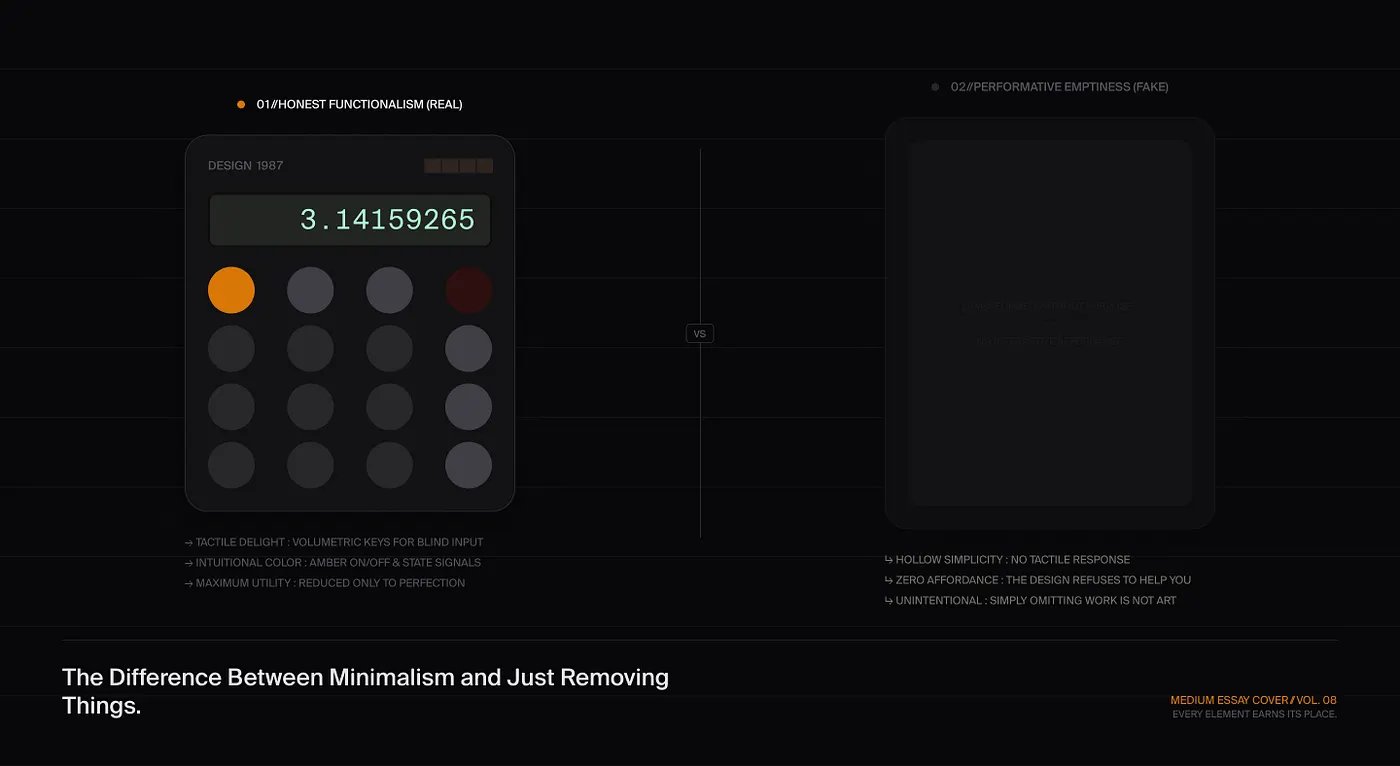
A lot of minimalism is fake, and honestly the fake version has gotten so good at copying the real thing that most of us don't even stop to ask which one we're looking at anymore. This has been bothering me for a while and I figured I'd just write it down.
The Idea Everyone Abandoned
In 1896, Louis Sullivan wrote "form ever follows function." The shape of something should be a direct response to what it needs to do, not what it needs to look like.
Spend five minutes on Dribbble and you'll realise that's a radical idea most designers have quietly abandoned, lol.
The Concorde
The Concorde is the one I love. Nobody sat down and said "let's make a beautiful plane." They said "let's cross the Atlantic in three and a half hours." That needle nose, those delta wings, the whole silhouette, all of it is a direct consequence of the physics of supersonic flight. The plane looks the way it looks because it had to. It's one of the most beautiful aircraft ever built and beauty wasn't even on the brief.
Bridges, Knives, Bicycles
Same with a suspension bridge. The geometry of those cables isn't an aesthetic choice. It's the most efficient way to distribute load. Engineers worked that out. Then everyone started putting them on postcards.
A chef's knife. A racing bicycle frame. A good pair of scissors. When the engineering is honest, the form tends to be honest too. Strip away everything that isn't doing a job and what's left has a kind of inevitability to it. And inevitability reads as beautiful. Not because someone decided it should be. Because it couldn't really be any other way.
That's the real argument for minimalism, by the way. Not that simple things look nice.
Performing Restraint
But a lot of what gets called minimalism right now has nothing to do with any of that.
Emptiness performing restraint. Sparse layouts not because everything unnecessary has been removed, but because sparse looks expensive. Products with hidden controls and no labels because visible affordances feel cluttered. Interfaces where you have to already know how something works to figure out how it works.
The Rest of the Rams Quote
Dieter Rams understood this. "Good design is as little design as possible" is the line everyone quotes, but people always leave out the rest of it: as little design as possible, while still achieving the purpose. That last part is basically the whole point, and it's the bit everyone conveniently skips. Cut it out and what you're left with isn't minimalism, it's just less stuff.
His work at Braun looks minimal, but every single decision in it was functional, the grid, the proportions, the placement of controls, all worked out from the inside out. Take away that rigour and honestly what you're left with is a beige rectangle.
What Ive Got Right
Jony Ive's best work at Apple operated the same way. The iPod click wheel, the first iPhone. The aluminium unibody MacBook isn't beautiful because someone decided aluminium looks nice. It's beautiful because milling a laptop from a single block of metal produces a rigidity and precision you feel every time you open it. The material choice was functional, the beauty followed.
Then It Inverted
And then there's the Magic Mouse you can't charge while using. The butterfly keyboard. Products that look incredible and are genuinely painful to live with, because somewhere along the way the form started making demands the function had to accommodate instead of the other way around. They still looked great. But you could feel the lie in them, and I think most people who used that keyboard daily know exactly what I mean.
So is beauty a byproduct of properly designed things? Yeah, I think so. But "properly designed" is doing a lot of work in that sentence.
It means honest. Every decision traces back to a purpose, nothing is there just to signal restraint or look good in a portfolio. You get real minimalism when that's true. What most people are actually doing is copying the outcome without doing any of the work that produced it, which, I don't know, is kind of like hearing a four-chord song and assuming the chords were the hard part.
Worth Knowing Which One
The Concorde is beautiful because the physics demanded it. Most of what we call minimalism today is beautiful because someone else's physics demanded it, and we liked the look. Worth knowing which one you're actually doing.